FOLLOW US ON:
The environmental impact of DelAgua’s cookstove programme is very significant. 90% of Rwanda’s rural population rely on wood for fuel. This has led to an increasing gap between wood supply and demand, driving a shortage of firewood and excessive forest depletion. The stove uses 71% less wood than traditional methods which in turn reduces deforestation. A preliminary research report on ‘The Forest Cover Impacts of Improved Cookstoves’ conducted by researchers at the University of Victoria, Trinity University and Bryn Mawr College examined the effects of DelAgua’s Tubeho Neza cookstove distribution programme from 2014 to 2023 on land cover in Rwanda. This report highlights the relationship between cookstoves and forest cover, a topic that has not yet been addressed by the literature.
The data used for this study includes:
1. Where and when Tubeho Neza was carried out
2: Vegetation cover from the imagery from the MODIS satellite.
*MODIS provides measures of the percent each pixel in Rwanda is covered in forest, non-forest vegetation (shrubs, grass, etc.), or non-vegetation (concrete, bare ground, etc.) from 2008 to 2020. Each pixel covers an area of 250 meters by 250 meters. It also provides a commonly used measure of general greenness called the “Normalized Difference in Vegetation Index” (NDVI) that we use.
This research uses an econometric method called “multiperiod difference-in-differences” to plausibly estimate the causal effect of Tubeho Neza on vegetation cover.
For this approach to estimate a causal effect, the following needs to be true: vegetation cover in cells that received Tubeho Neza would have changed in the same way over time had they not received Tubeho Neza, as forest cover in the cells that did not receive Tubeho Neza.
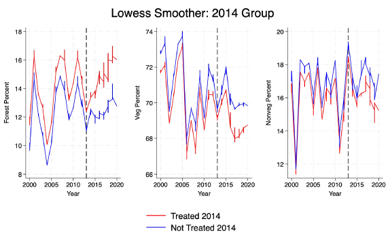
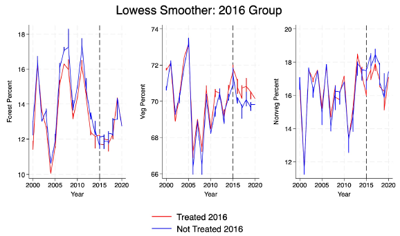
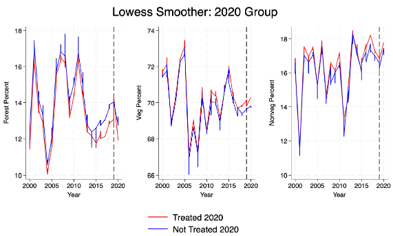
This research looked at average trends in vegetation cover prior to the implementation of Tubeho Neza for the cells that received the programme and compared them to those cells that did not.
The above graphs show that all vegetation measures evolve similarly over time for cells that received Tubeho Neza compared to those that did not, prior to the implementation of the programme.
Tubeho Neza causes a 2.464 percentage point increase, on average, in forest cover.
The research in general shows that the effects on forest cover steadily grew over time.
The effect of Tubeho Neza on forest cover was strongest in cells that had previously healthy forest cover: In cells in the top quarter of the healthiest forests in 2008, there was an effect on forest cover of 3.14 percentage points, on average.
The effect on non-forest vegetation was positive for all cells in the bottom three quarters of 2008 forest coverage: An increase of between 1.318 and 2.144 percentage points, on average
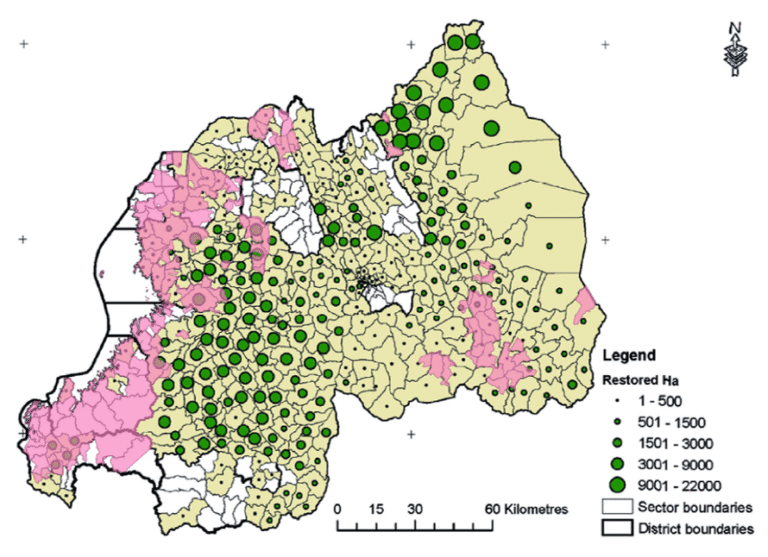
Rwanda heavily invested in reforestation starting in 2004. We were concerned that Rwanda may have made investments in reforestation in roughly the same locations and at the same times as Tubeho Neza.
This figure (right) illustrates the number of hectares reforested in each sector in Rwanda between 2011 and 2018. It shows that the sectors with the most hectares reforested are not in the areas that are driving the strong positive effect of Tubeho Neza on forest cover, shown in pink.
This, therefore, suggests that this preliminary research is not attributing Rwanda’s reforestation efforts to Tubeho Neza. Additionally, it indicates that the estimates are an underestimate of Tubeho Neza’s impact and the upcoming quantitative research will provide more data.
Dave, R., Saint-Laurent, C., Murray, L., Antunes Daldegan, G., Brouwer, R., de Mattos Scaramuzza, C.A., Raes, L., Simonit, S., Catapan, M., García Contreras, G., Ndoli, A., Karangwa, C., Perera, N., Hingorani, S. and Pearson, T. (2019). Second Bonn Challenge progress report. Application of the Barometer in 2018. Gland, Switzerland: IUCN. xii + 80pp.
Preliminary findings indicate that Tubeho Neza resulted in statistically significant increases in greenness in treated Cells.
Get in touch with DelAgua’s Chief Technology Officer to discover more about Live Well’s impact in Rwanda, The Gambia and Sierra Leone.
FOLLOW US ON: