

FOLLOW US ON:

The environmental impact of DelAgua’s cookstove programme is very significant. 90% of Rwanda’s rural population rely on wood for fuel. This has led to an increasing gap between wood supply and demand, driving a shortage of firewood and excessive forest depletion. The DelAgua stove uses 71% less wood than traditional methods which in turn reduces deforestation.
A report on ‘The Forest Cover Impacts of Improved Cookstoves’ conducted by researchers Abubakr Ayesh, Colette Salemi and Sebastian Anti at the University of Victoria, Trinity University and Bryn Mawr College examined the effects of DelAgua’s Tubeho Neza cookstove distribution programme from 2014 to 2023 on land cover in Rwanda. This study is a first step towards causally evaluating the impact of improved cookstoves on forest cover.
The researchers combined DelAgua’s stove distribution records (covering all distributions to date, down to village level) with two satellite data sources: MODIS Terra Vegetation Continuous Fields (VCF) (250m resolution, 2000–2023) which provides the percent of land cover characterized as forest, non-forest vegetation,
or non-vegetated, and bespoke Landsat-derived land cover classifications (30m resolution, 2012–2023). They constructed a panel dataset covering all 2,148 of Rwanda’s administrative cells over 24 years.
Their primary econometric approach is a staggered difference-in-differences (DID) design using the Mundlak regression estimator, which accounts for the fact that different areas received stoves at different times. They define treatment cohorts based on the first year a cell received any Tubeho Neza stoves and compare treated cells to the 8.9% of cells that never received stoves during the study period. The design controls for cell-level fixed characteristics, province-level time trends, population, precipitation, and temperature.
The quantitative analysis is supplemented by qualitative fieldwork conducted in August–September 2025: twenty focus group discussions (ten each with men and women) across five districts, eight key informant interviews with district leaders. The qualitative fieldwork helps ensure that the estimates are not influenced by overlooked factors and that the approach considers both user demand and competition from similar programs offered by other providers.
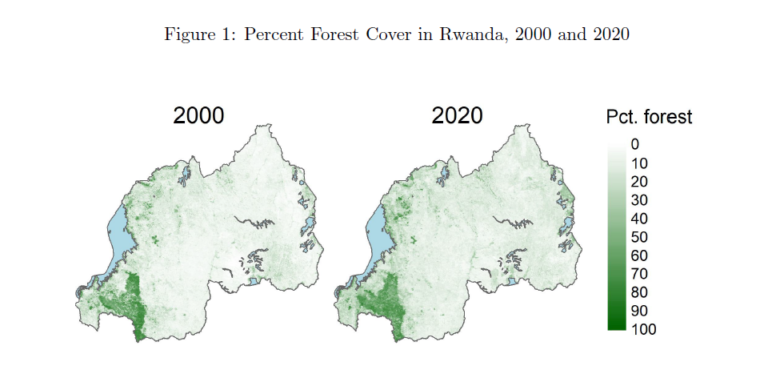
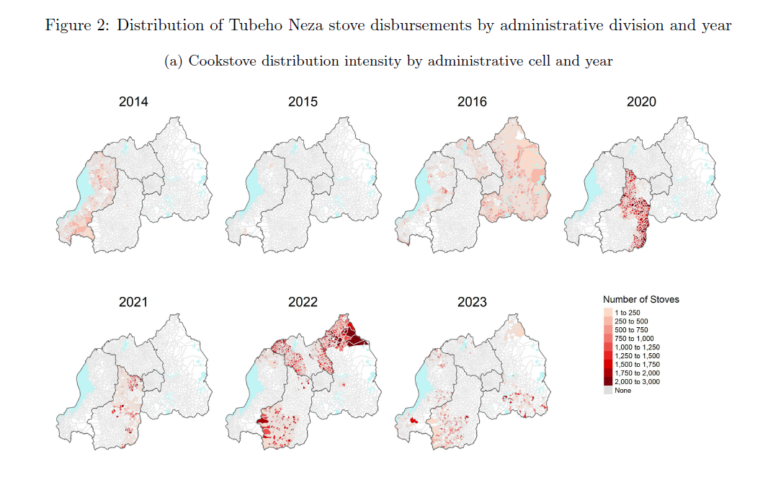
The study used cookstove distribution data provided by DelAgua, which includes details of all cookstoves distributed by DelAgua to date. The data is very detailed, providing the beneficiary’s administrative location down to the village level, as well as a timestamp documenting when the cookstove was first delivered to the household.
+ 0.61 percentage point increase in forest cover (tree canopy).
4.4% increase relative to the sample mean.
This represents an average increase in forest cover by 9.7 football pitches annually.
+ 1.26 percentage point increase in non-forest vegetation.*
1.8% increase vs. mean.
The effect is equivalent to a marginal increase of cover by 19.9 football pitches each year.
*This can include shrubland and grasslands, and sparsely treed landscapes.
-1.87 percentage point decline in non-vegetated area.
Equivalent to 29.6 football pitches. This indicates that land previously classified as bare or built-up is transitioning into vegetated cover.
Heterogeneous Effects & Implications
By Baseline Forest Cover
Top Quartile (most forested)
+2.26 pp forest cover
Bottom Quartile (least forested)
−0.90 pp forest cover, but +1.87 pp non-forest veg.
Heterogeneous Effects & Implications
By Treatment Cohort
2014 cohort (Western Province): +3.09 pp forest cover – only cohort with significant forest gains
2016–2023 cohorts: Gains in non-forest vegetation; forest effects may need more time to materialise
All cohorts: Significant decline in non-vegetated area
Qualitative Findings
Fuelwood spend cut from ~10,000 to 3,000–4,000 RWF
Children less likely to miss school for firewood collecting
Strong demand for two-burner stove design
The research found that treated cells experienced an average increase in vegetation cover.
In the MODIS data, stove receipt is associated with a 0.61 percentage point increase in forest cover, a 1.256 percentage point
increase in non-forest vegetation, and a 1.866 percentage point decline in non-vegetated area.
These changes emerge gradually over time, which is consistent with the time required for vegetative recovery to become visible
in satellite imagery. The robustness checks point in the same direction.
Interviews and focus groups added context: households did use the stoves, spent less on firewood, and relied less on children to gather it. Local leaders confirmed that where the programme rolled out first wasn’t driven by environmental factors, and that competing tree-planting or cookstove initiatives only began near the end of the study period. Together, this supports the case that the land-cover changes trace back to the stove program itself.
The central substantive finding is that the environmental effects of improved cookstoves are positive but heterogeneous.
Places that already had healthier forests saw actual forest regrowth.
Places that started with degraded forest saw vegetation gains outside the strict “forest” category.
This isn’t a lesser outcome – it just means recovery looks different depending on the starting point. Cutting demand for firewood doesn’t automatically produce more forest everywhere; it produces more vegetation, and whether that counts as “forest” depends on the ecological baseline.
Why this matters
Beyond health and time savings, cookstove projects can deliver real environmental benefits.
It’s relevant to carbon-credit debates. This doesn’t settle questions about carbon additionality, but it does show large-scale cookstove programmes can measurably change land cover, including actual forest gains in the right conditions.
Get in touch with DelAgua’s Chief Technology Officer to discover more about Live Well’s impact in Rwanda, The Gambia and Sierra Leone.
FOLLOW US ON: