DelAgua's Last Mile Distribution
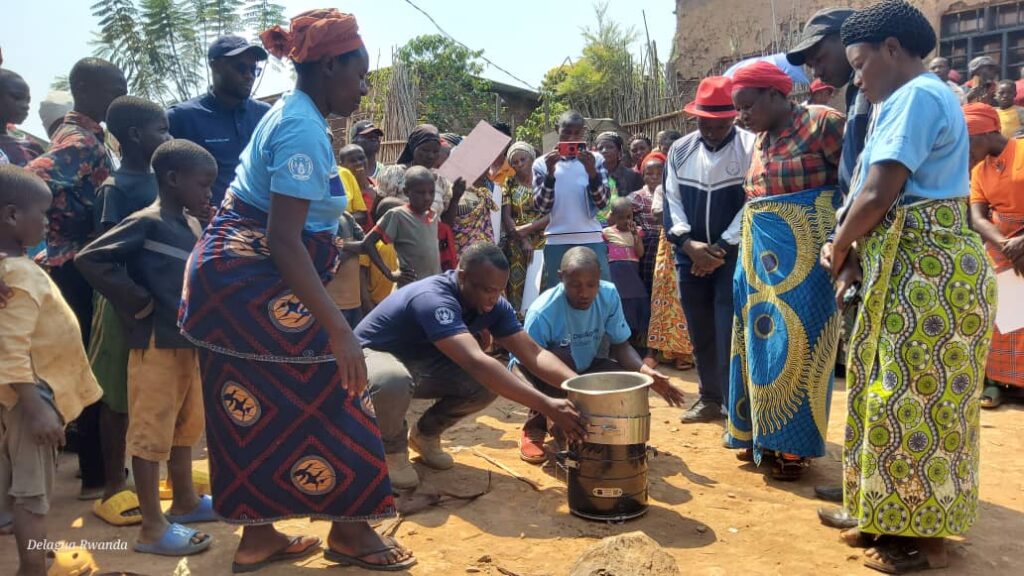
DelAgua’s Live Well programme works exclusively with rural communities to provide much needed high quality, fuel-efficient cook stoves free of charge. Over the past decade, DelAgua has developed a highly efficient project implementation system that allows our programme to reach even the most remote villages in the countries where we operate.
Since the project’s inception in 2012, DelAgua has distributed 2 million stoves; the majority of them delivered to rural areas that are not easily accessible due to limited road infrastructure or geographical isolation.
A STOVE FOR EVERY RURAL HOUSEHOLD
At DelAgua, we believe that every rural household should have access to cleaner and more efficient cooking. Through our partnership with national governments and local leadership, we are able to target vulnerable communities that are at risk of being left behind in the transition to clean cooking either due to lack of affordability or inaccessible locations.
Our extensive pre-planning processes also enable us to tailor operational, and logistics needs to the region’s terrain to ensure effective project implementation.
The preplanning process includes door to door beneficiary name collection; accurate national household data does not exist for every one of the 321,000-beneficiary households in Sierra Leone and The Gambia, and beneficiary list verification with sector and cell level officials in Rwanda.
NAVIGATING RURAL ROAD NETWORKS
In many African rural areas, the roads leading to the villages are often unpaved and impassable, especially during rainy seasons. As a result, the cars and trucks supporting distributions and household visits risk getting stuck and causing delays in project timelines.
In addition to this, some of Sierra Leone’s villages are so far apart from each other that beneficiaries from smaller villages are often not able to walk the long distances to the distribution sites. In these cases, our teams have adapted to using motorbikes to transport the stoves to the smaller communities, bringing the programme even closer to households. This is common in Koinadugu, Kambia & Kenema districts.
In The Gambia, our teams have encountered similar challenges in Lower, Central & Upper River regions.
To address this issue, DelAgua conducts field activities during the dry seasons, and desk planning and analysis during the rainy season which usually last 2 – 3 months.
Additionally, the 40-foot trucks that transport the stoves from our warehouses stop at the district level, where the stoves are then moved onto smaller trucks that are able to drive on the dirt roads up to the village distribution locations.
DISTRIBUTIONS ON LAKE KIVU ISLANDS
Lake Kivu is Rwanda’s largest lake and home to at least 40 islands, with Nkombo island being the largest with a population of approximately 18,000 people.
As a result of the island’s distance from the mainland shores, residents of these islands are often left behind in private sector development projects such as access to clean cooking.
In 2025, DelAgua commenced distributions on these islands, and 3,510 stoves have been distributed so far across 2 islands: Nkombo & Ishywa in Rusizi District.
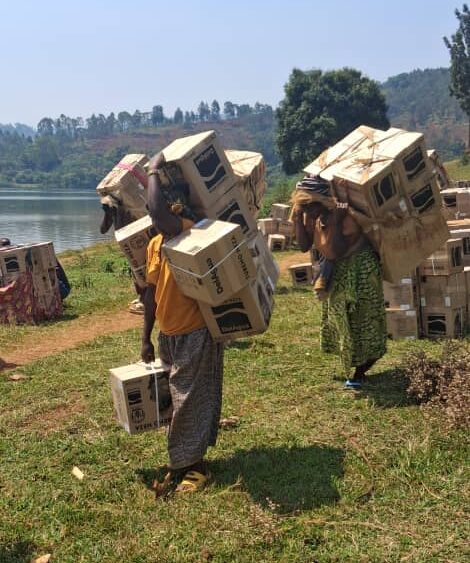
The stoves are transported to the shore by small trucks and then loaded onto boats that deliver them to the islands. At the islands, DelAgua hires locals to carry the stoves to the nearby distribution location.
Jean Claude Niyibizi, a District Manager with DelAgua, shared his experience conducting distributions in these two islands.
“During microplanning we observed that the residents of Nkombo Island were in desperate need of clean cookstoves. This is because no other company has been able to transport stoves to the island. The island’s cells are scattered throughout Lake Kivu, and taking a boat to see each one was an eye-opening experience. The programme was warmly welcomed by the residents, to the extent that every day after work, Community Health Workers would prepare food for us and share a meal with us.”
One of the unique aspects of DelAgua’s Live Well programme is that it is designed and delivered by locals (DelAgua staff & Community Based Workers), who have a deep understanding of the region and how to navigate such logistical challenges. This means we can reach underserved communities that have previously been sidelined or forgotten, ensuring they too gain the life changing benefits of clean cooking.